
AI, Search and Your Event, 10 Things You Need to Know to Stay Visible
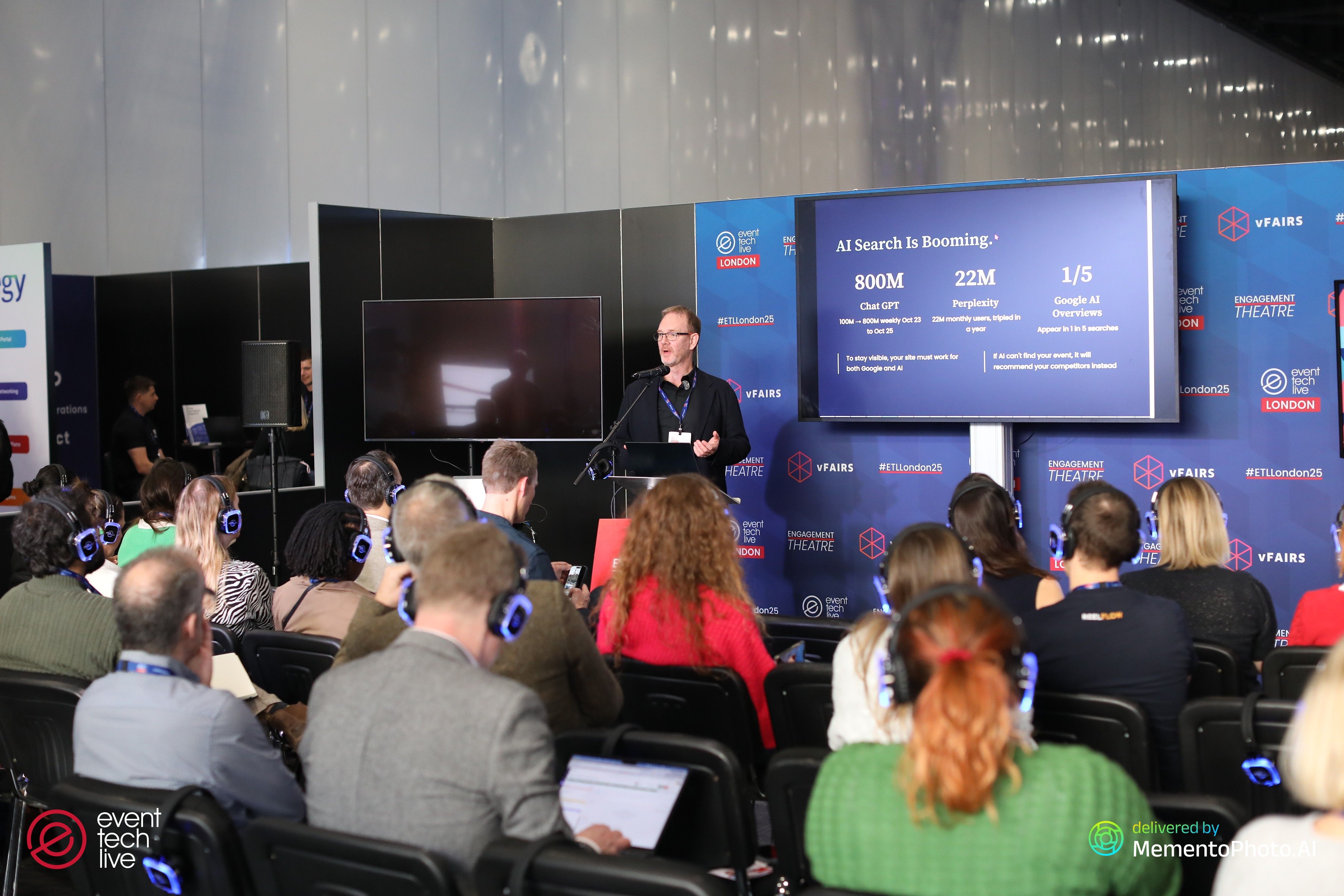
- Event: Event Tech Live
- Speaker: Jon Monk
- Date: 13 November 2025
Quick Read Summary
This session explored how event organisers can keep their websites visible as artificial intelligence becomes a major route for discovery. Jon explained why strong performance in Google still matters, how AI engines use web content, and what event teams can do today to ensure their shows appear in both traditional search and emerging AI results.
The session outlined ten practical steps including retaining high value content, capturing conference sessions as searchable resources, building topic pages, adding detailed speaker and exhibitor profiles, and publishing consistently throughout the year.
Jon emphasised that event websites often rely far too heavily on their brand name alone and miss wide areas of potential search traffic.
The message was clear. If events want to show up in AI engines, they must first demonstrate value, authority and clarity on their own websites. The long term winners will be those who treat their show websites as year round information hubs rather than temporary promotional sites.
AI Is Changing Search, But Core Principles Remain
Jon opened the session with a simple question to the room. Had anyone used Chat GPT or any AI tool in the previous twenty four hours. Many hands went up, signalling the shift that has happened across almost every industry.
He explained that although AI usage is growing at enormous speed, the foundations of search remain largely unchanged. AI engines need source material and they rely heavily on established search engines such as Google to find it.
He stated “The new AI engines are not completely different to what you already had to do to rank in Google. A lot of the same principles apply.”
However, he stressed that websites must now be ready for both environments. AI engines do not guess what a site is about. They look for detail, clarity and relevance. If an event brand website contains only dates, logos and a short description, the AI has nothing meaningful to work with.
This is why event websites that become information rich, rather than simply transactional, are the ones that will be surfaced by AI engines.
Why Google Can Not Be Ignored
While the rapid rise of tools such as Chat GPT is impossible to overlook, Jon reminded the audience that today Google still dominates web discovery by a wide margin. He emphasised that visibility in Google remains essential for anyone wanting to succeed in AI search.
Back in April, Google restricted how deeply AI crawlers could access their index. AI engines can still retrieve information from Google, but only from the top section of results. If content is not already ranking within the top ten, the AI engines may simply never see it.
Put plainly. “If you are not in Google, you will make your job a lot harder in the AI engines too.”
This means traditional search engine optimisation is no longer optional. Strong Google visibility has become a gateway to strong AI visibility.
People Are Searching in Longer, More Specific Ways
Search behaviour is changing. AI has normalised question based searching and people now expect direct answers rather than lists of links.
Jon gave an example relating to a farming equipment show. A user may ask, “Where can I find the top suppliers of heavy farming equipment”. If the show website does not explicitly state that it hosts a collection of leading heavy farming equipment suppliers, the AI engine will not infer it. The language must be written clearly on the site.
Event websites often assume brand familiarity. Many rely on recognition of the show name rather than descriptive content - he warned that this approach prevents both Google and AI engines from fully understanding what the event offers.
To appear for these richer, more natural searches, events must answer such queries directly on their websites.
Ten Practical Steps To Improve Visibility
Jon then moved into the main part of the talk, outlining ten actions that any event team can take to improve visibility in both Google and AI engines.
1. Stop Removing High Value Content After the Show
Most event websites follow the same cycle. Content increases before the show, remains high during the event, then disappears when the event closes. Speaker pages, exhibitor lists, news posts and session descriptions are often deleted.
Jon said “Deleting these pages absolutely kills your organic traffic.”
Older speaker pages in particular can bring steady traffic for years if they include rich information. A well known speaker may have appeared at a show three years earlier yet still attract searches every month. Removing their profile removes that ongoing benefit.
He advised organisers to check Google Search Console to see which pages generate traffic. Anything that continues to perform should remain on the site and be moved into past event sections if needed.
2. Capture Sessions and Turn Them Into Searchable Content
Monk recorded his own session and encouraged organisers to do the same with all conference content. Audio alone is affordable and can easily be transcribed.
A transcription can become a detailed blog post that remains useful long after the event ends. This transforms the event from a three day moment into a year long educational resource.
Monk said, “You now have a piece of content that is valuable. It is something others can discover months later and it introduces them to your event.”
For events with many sessions, this becomes an ongoing content pipeline.
3. Build Topic Pages To Organise Your Expertise
If an event covers broad subjects such as artificial intelligence, robotics or machine learning, users need simple routes to find what matters to them.
Monk recommended creating topic pages that gather related speakers, exhibitors, sessions and articles. These pages also help search engines understand the structure of the content.
He likened the approach to a library. Without categories, no one can find what they need. Topic pages act as the shelves that bring order and clarity.
4. Conduct Keyword Research To Understand Demand
Monk suggested using Google Keyword Planner to identify what people genuinely search for. Instead of broad terms such as artificial intelligence, users often search phrases such as AI events, robotics conference or machine learning sessions.
These insights guide the creation of topic pages and ensure content aligns with real user interest.
5. Avoid Hiding New Content
Some organisers request topic pages or session posts but wish to hide them from the main menu. Monk strongly advised against this.
Hidden pages are hard for users and search engines to find. If the content is genuinely valuable, it should be visible and linked from relevant parts of the site.
6. Add Detailed FAQ Sections Across the Site
Question based searching is increasing, and FAQs provide immediate answers. Monk encouraged adding tailored FAQs to significant pages, not just a single global FAQ page.
He explained that each key page will attract specific questions. Adding these to the bottom of the page provides clarity, supports search visibility and helps guide users towards registration.
7. Strengthen Speaker Profiles With Original Text
Monk highlighted that many speaker profiles contain only a name, job title, or text copied from LinkedIn. This limits visibility.
Unique content performs far better. It helps search engines recognise the authority of the individuals involved and improves the long term discoverability of the event.
He also noted that high performing speaker pages can become valuable assets for years, especially when the speaker has strong recognition.
8. Improve Exhibitor Profiles and Use Them for Visibility Opportunities
The same principles apply to exhibitors. Many event websites display only a logo and a link.
Unique rewritten descriptions allow these profiles to rank independently. For smaller businesses, the event website may even outperform their own site in search visibility.
Monk suggested that this can create commercial opportunities. Extended visibility packages can offer exhibitors more presence before and after the show.
9. Publish Content Regularly Throughout the Year
Search engines trust sites that update consistently. If a site only publishes once a year, search crawlers stop visiting frequently.
Dripping out transcribed sessions, blog posts, updates and insights keeps the site active and signals that it is a reliable source of ongoing information.
10. Measure Visibility Using Google Search Console
Monk closed the list by stressing the importance of visibility measurement. Many organisers simply do not know how well, or how poorly, they perform.
Google Analytics shows traffic from all channels, while Google Search Console reveals performance specifically within Google search. It shows keywords, impressions, ranking positions and the visibility of individual pages.
Monk said that when organisers first see the data, many realise they rank only for their brand name and nothing else. It becomes a clear wake up call that prompts further action.
A Changing Landscape With Clear Opportunities
Monk summarised the session by acknowledging that while AI is reshaping discovery, strong Google performance remains essential. Everything recommended in the ten steps will help events appear in both traditional search and emerging AI engines.
He reflected on the state of event websites today. “Most event websites do not publish content and they do not rank well for anything apart from their brand.”
This creates significant opportunity. Events that adopt a year round content approach, build information rich pages and maintain their archives will stand out quickly in their sector.
He added that well optimised websites can also reduce pay per click costs, because search engines can better understand who the event is for and send more relevant traffic.
Key Takeaways
-
AI engines need clear and detailed content, and they rely heavily on Google to find it
-
Strong Google visibility increases the likelihood of appearing in AI generated results
-
Event websites must move beyond simple promotional pages and become information hubs
-
Do not delete speaker or exhibitor profiles that attract ongoing traffic
-
Transcribe and publish session content for year round visibility
-
Build topic pages to organise content and demonstrate expertise
-
Use keyword research to understand what users genuinely search for
-
Create rich, original profiles for speakers and exhibitors
-
Publish consistently to maintain search engine trust
-
Use Google Search Console to monitor performance and identify opportunities
Get an AI Visibility Assessment
Book your AI Visibility Assessment and discover how your website performs across platforms like ChatGPT, Perplexity, Claude and Copilot.
Speaker Bio
A Search Engine Optimisation specialist at ASP and has worked in digital search across finance, small business, ecommerce and events.
He has spent the last four years focused entirely on the events sector, helping organisers build websites that attract and convert audiences throughout the year. He combines technical SEO expertise with deep knowledge of event cycles to guide organisers towards sustainable organic visibility.