
Is Your Event Invisible to AI? What to Check and How to Fix It
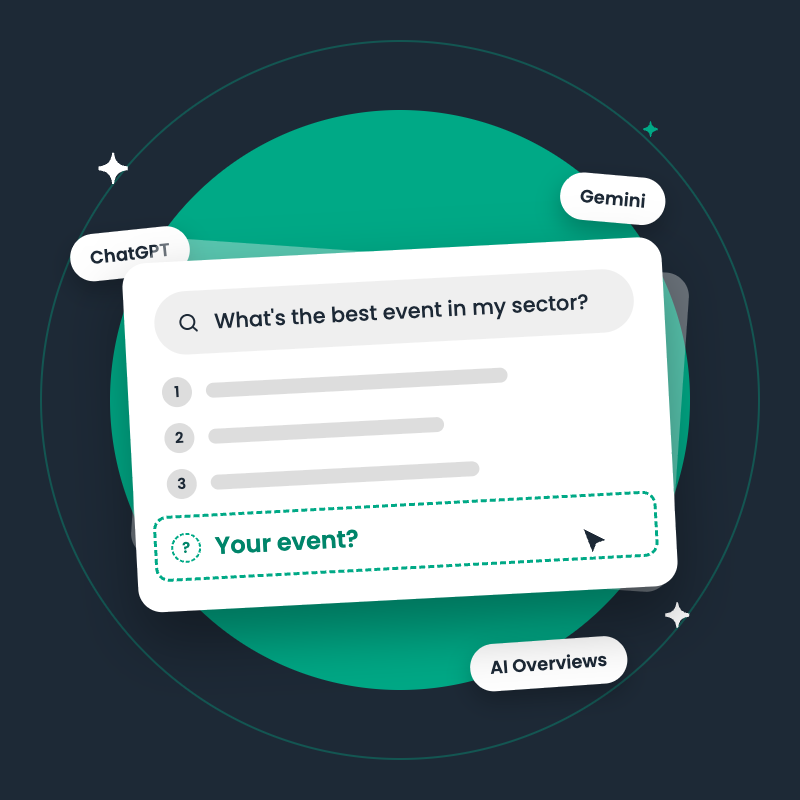
Ask ChatGPT, Gemini or Google's AI Overviews to recommend an event in your sector and something comes back. Whether it's your event, and whether the information is accurate, are the big questions.
AI visibility moves weekly, so ASP's September webinar covered what's changed recently. Jon Monk, Head of Performance at ASP, showed what to check using tools you already have, with live audits of real events and a checklist you use immediately.
The session was the first in a new series on AI visibility. It set out to answer some important questions:
- Does AI recommend your event?
- Is what it says correct?
- Can AI actually read your website?
- What can you do about it?
AI search changes fast. A few updates from the weeks before the session:
- ChatGPT launched a new model in early September. Like a Google algorithm update, a new model changes how it finds and weighs information. Any visibility checks you ran before need running again.
- Google's AI Overviews now show the full AI answer at the top, above the traditional links.
- Google is testing links from AI Overviews into more AI, keeping users inside its own environment.
- Google's AI can now track flights and help book hotels in the UK. Your attendees will plan their trip to your event there.
- Traditional Google search is still updating, with changes rolling out in September to stop people manipulating results.
- YouTube is starting to answer questions inside videos.
The theme is clear. Every platform wants to keep users on its own turf and answer as much as possible there.
People now do the majority of their research inside AI tools before they reach your website. A year or two ago, you might open eight tabs and read your way through each site. Now one AI conversation does the job.
Across several ASP clients, Jon is seeing website visits drop while conversions and conversion rates go up. The tyre kickers stay in ChatGPT. The people who do arrive have already made their decision.
That makes your website more valuable, not less. The real question is whether visitors are deciding based on the right information.
AI is growing fast, but traditional search is still a giant. Google sends around 100 times more visitors to websites than ChatGPT.
The AI engines also rely on Google and Bing to find your website. Rank well in Google and Bing, and you're much more likely to be picked up by ChatGPT, Claude and Gemini.
AI engines organise information into topics, much like traditional search engine optimisation (SEO) groups keywords. Few brands are claiming the topics that matter to them.
Take an AI event. Its audience might search for machine learning, robotics and plenty of other related terms. If those topics aren't identified and built into the website, someone searching for "machine learning event" won't find it.
For event organisers, this is a quick win. Events can often see decent results within a few months unlike other sectors such as financial services where the same gains can take a year or two. If you need help identify the topics their audience searches for, then builds pages and content around them.
Keyword research still matters here. AI tools don't share how often people use a given prompt, but Google's search data does. It shows, for example, whether more people search for "farming events" or "agricultural events", so you know which topics and prompts to prioritise.
We've helped lots of clients improve in this area by identifying the topics their audiences search for and then building pages and content around this. Give us a shout if you'd like us to help you too!
Jon ran live Google searches for "best farming events", "best heavy machinery event" and "best literary festival" to see what AI recommends and where it gets its information. Four lessons stood out.
- Be bold about what you are
Bauma ranked strongly for heavy machinery. Its page title and meta description call it the world's leading construction machinery trade fair, which matches what people search for. Its own website appeared above Wikipedia, which is exactly where you want to be. Too many events shy away from claims like this. - Beat Wikipedia and third-party blogs
For several well-known festivals, Wikipedia or third-party articles appeared above the event's own site. One major literary festival's ticket information came from a holiday cottage company's blog post. If a third party is answering questions about your event, publish something better on your own website. - Keep a tickets or registration page live all year
Even if you use a third-party ticketing or registration platform, keep a permanent tickets or registration page on your site that links to it. Add it to the footer if needed. That's how you show up when AI pulls in ticket and price information. - Use tables
Google and AI engines love tables. Key event details set out in a table, on a What's On or tickets page, can be pulled straight into AI answers.
Ask the same question twice and you'll often get different answers. Only around 40% of sources match between repeat runs of the same question. That makes AI visibility harder to measure than traditional rankings.
AI also makes things up. These tools are designed to please, so instead of saying "I can't find that", they give an answer that sounds right. One ASP client found ChatGPT naming a partner as co-organiser of their event. It was completely wrong, and the source couldn't be traced. The fix was stating the organiser clearly on the right page.
Wrong answers usually mean your website isn't sending strong enough signals. Common causes include:
- Out-of-date details hidden behind the scenes. Teams update the homepage and key pages for the next edition, but miss event schema markup and meta titles and descriptions. Details can be right on six pages and wrong on 3,000. Crawling tools such as Screaming Frog can help you find them.
- Time lag. A previous edition's venue may still appear if updates were made recently.
- Gaps AI fills from elsewhere. If your site doesn't answer a question, AI looks at your registration platform, LinkedIn or anywhere else it can find.
Some content is easy for AI to read. Some isn't.
JavaScript widgets
ASP websites are built in HTML, which search engines and large language models read easily. Many third-party widgets for speakers and exhibitors use JavaScript. They can look great, but AI engines often don't wait for them to load before moving on.
There's a quick test. Check the URL of an individual speaker or exhibitor. A URL such as /exhibitors/company-name is a real page search engines can read. A hash (#) in the URL is a good sign it's loaded by JavaScript and may be invisible.
This matters more than it sounds. For one client, Jon found speaker pages were a hidden source of organic traffic across several event websites. Over a year, that free traffic can equal a sizeable pay-per-click (PPC) budget.
PDFs
Floor plans, exhibitor lists and brochures often sit in PDFs. Google is starting to deprioritise PDFs in search results because they're harder to read than web pages. Keep the download, but publish an HTML page version too.
Third-party platforms come and go. Posting on Reddit was a popular way to get cited in ChatGPT, but Reddit's traffic from ChatGPT has fallen sharply recently. LinkedIn articles are performing well right now, but that may change too.
What doesn't change is how AI engines treat a brand's own website: as the source of truth. Event websites have a natural advantage. They feature leading speakers and top companies in their industry, so they're well placed to be seen as an authority.
PPC, email and social still play a vital role in exhibitor and visitor promotion campaigns. Paid media is needed as much as ever.
But as more research happens inside AI tools, you need to show up there, above your competitors, all year round. It may be worth moving some PPC and social budget into optimising your website for AI visibility. For events, it's typically far less work than in other industries.
Run these checks in ChatGPT and Gemini this afternoon:
- Are you named when you ask for the best events in your sector?
- Do you show up for every topic your event covers, not just the main one?
- Are the facts correct? Check dates, venue, organiser, exhibitors and speakers.
- If something is wrong, can you trace it to old page titles, meta descriptions or event schema on your site?
- Does your homepage state your event name, dates, venue, audience and registration status in actual text? Not in a logo, an image or a vague headline like "Explore the possibilities for 2027".
- If you use widgets, can search engines find your individual speaker and exhibitor pages?
- Do your PDFs have HTML page versions?
- Do you have a set of prompts you run every month to track how your event shows up?
Tips for running your prompts:
- Use ChatGPT's temporary chat. It draws on less of your history, so you get a cleaner answer.
- Ask the same question more than once, in more than one tool.
- Ask the questions a buyer would ask. Assume they don't know your event name.
Watch the Webinar On Demand